For years, Word games have trained us to chase an answer hidden just out of reach. We stare at a blank grid, type a hopeful first guess, watch the tiles change color, and then begin the familiar ritual of deduction. Green means stay. Yellow means move. Gray means abandon ship. It is simple, elegant, and almost dangerously addictive.
But the newest wave of Wordle-inspired puzzles asks a far stranger question: what if the answer was not hidden at all?
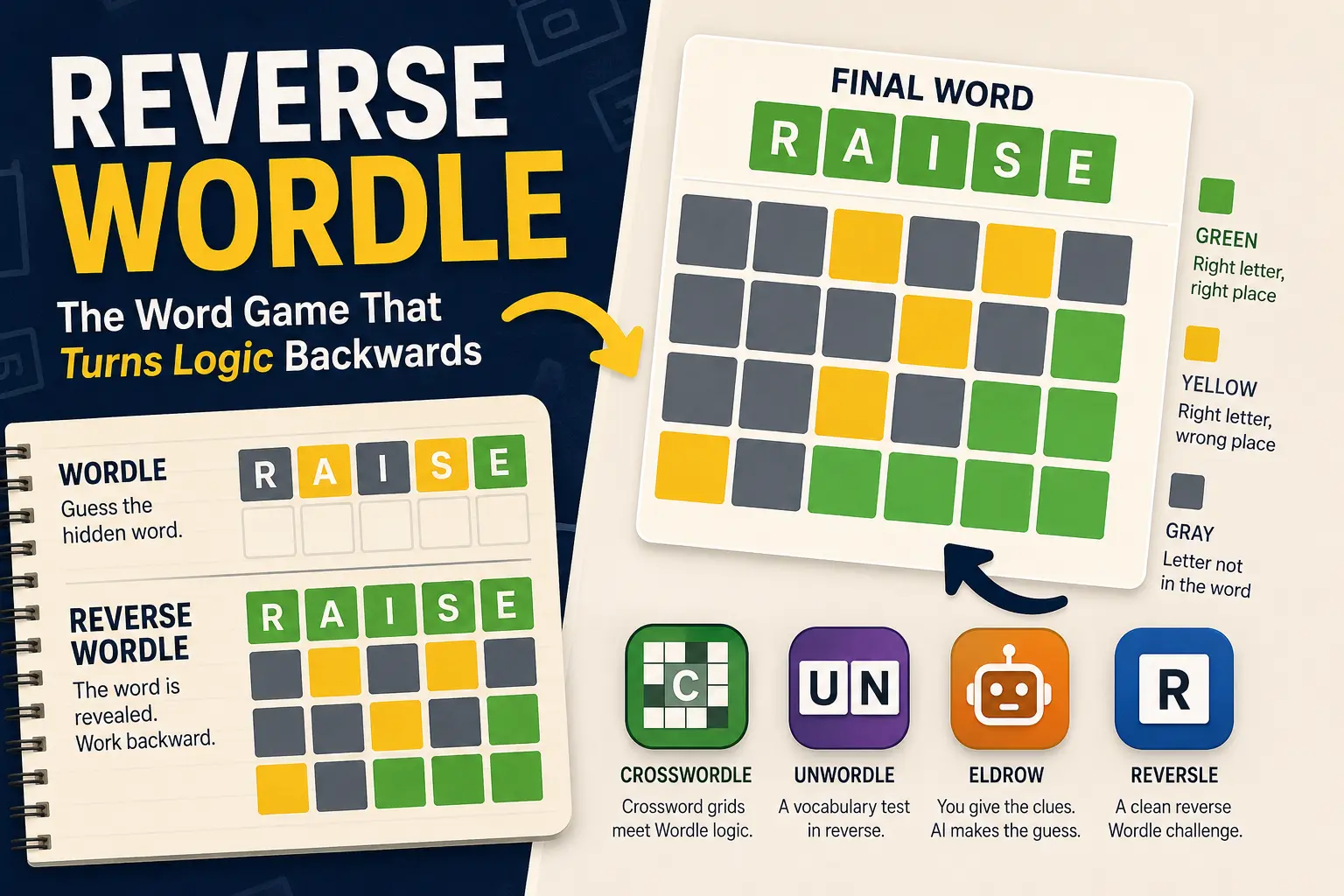
That is the central idea behind reverse Wordle, a growing corner of the word-game universe where the final word is already known and the player’s job is to work backward. Instead of hunting for the solution, you reconstruct the logic that could have led to it. Instead of asking, “What is the word?” the game asks, “How could we have arrived here?”
It sounds like a small twist. In practice, it changes everything.
Reverse Wordle games turn the familiar language of green, yellow, and gray tiles into something closer to a forensic puzzle. You are no longer simply guessing. You are building a trail of evidence. Every letter must justify its place. Every wrong move must still be logically compatible with the answer you can already see. The result is a genre that feels both familiar and new, both accessible and surprisingly demanding.
For crossword fans, logic-puzzle lovers, and daily-game obsessives, reverse Wordle may be one of the most interesting developments in online word games right now.
What Is a Reverse Wordle?
A reverse Wordle is a word puzzle that flips the classic Wordle structure. In traditional Wordle, the player begins with an unknown five-letter answer and uses color-coded clues to narrow it down. In a reverse Wordle, the final answer is already revealed or strongly implied, and the challenge is to create, rearrange, or identify the words that satisfy the color clues leading toward that answer.
The basic language is still familiar. Green tiles usually mean the letter is correct and in the correct position. Yellow tiles mean the letter belongs in the word but is sitting in the wrong place. Gray tiles signal letters that should not be part of the target word at all.
But the mental direction changes. In standard Wordle, each guess is a question. In reverse Wordle, each entry is more like an explanation.
That is why the genre feels so different. Classic Wordle rewards efficient discovery. Reverse Wordle rewards controlled reconstruction. You are not just solving the ending. You are proving the path.
Why the Reverse Format Feels So Fresh
The genius of Wordle was never just that it was a word game. It was that it gave players a clean daily ritual. One puzzle. Six guesses. A grid of feedback. A shareable result. It transformed a small act of vocabulary and logic into a social habit.
Reverse Wordle builds on that same foundation but changes the emotional rhythm. Instead of the suspense of not knowing, it gives players the pressure of knowing too much. The answer sits there, almost smugly, while the grid demands that you reverse-engineer the route.
This changes the player’s relationship with the puzzle. You cannot simply throw out a strong starting word and react to the result. You must plan. You must think about how a word would be judged against the visible target. You must treat every row as part of a logical chain, not as a disposable guess.
That makes reverse Wordle feel less like a guessing game and more like a puzzle box.
It also explains why crossword players may find the format especially appealing. Crosswords are not only about knowing words. They are about intersections, constraints, clue interpretation, and the satisfaction of watching separate pieces lock into place. Reverse Wordle shares that same pleasure. It asks players to respect the structure of the grid, not merely the meaning of the answer.
The Color Code Still Matters
To understand reverse Wordle, you need to understand why the Wordle color system became so powerful in the first place. It compresses a lot of information into a tiny visual signal.
A green tile gives certainty. That letter belongs exactly where it is.
A yellow tile gives partial certainty. The letter belongs somewhere, but not there.
A gray tile removes a possibility. The letter should not appear in the target word.
In classic Wordle, those signals help you move forward. In reverse Wordle, they become constraints you must satisfy backward. A green tile is not just helpful; it is a demand. A yellow tile is not just a clue; it is a placement problem. A gray tile is not just bad news; it is a rule you must not violate.
This is where the game becomes unexpectedly sharp. A word may look plausible at first glance, but if one letter would create the wrong color response, the entire row collapses. You are solving not only for vocabulary but for compatibility.
The best reverse Wordle games understand this. They do not merely copy Wordle’s colors. They use those colors as the skeleton of a new kind of challenge.
Reverse Wordle vs. Classic Wordle
The difference between Wordle and reverse Wordle is not simply that one goes forward and the other goes backward. They reward different skills.
| Feature | Classic Wordle | Reverse Wordle |
|---|---|---|
| Main objective | Find the hidden word | Reconstruct or satisfy the path to a known answer |
| Player mindset | Guess, test, narrow down | Analyze, reverse-engineer, validate |
| Core tension | “Can I discover the answer in time?” | “Can I make the clues logically work?” |
| Main skill | Deduction and vocabulary | Logic, constraint solving, and vocabulary |
| Best feeling | A sudden breakthrough | A clean reconstruction |
| Common frustration | Running out of guesses | Finding valid words that fit all rules |
Classic Wordle is built around uncertainty. Reverse Wordle is built around accountability. You can see the destination, but every step toward it has to make sense.
That is why many players find reverse Wordle harder, even when the rules appear simple. Knowing the answer does not remove the challenge. It relocates it.
Why Reverse Wordle Can Be Harder Than It Looks
At first, reverse Wordle may sound easier than the original. If the final word is visible, what is left to solve?
The answer: almost everything.
In a normal Wordle puzzle, a player can make a useful guess even without knowing much. A strong starting word with common vowels and consonants can generate information. The game gives feedback, and the player adapts.
Reverse Wordle is less forgiving. You already know the answer, so the puzzle is not asking you to discover information. It is asking you to obey information. That subtle difference makes every move more constrained.
You may need a valid word with a specific letter in the wrong position. You may need to avoid letters that would accidentally become green. You may need to include a letter without placing it where it obviously wants to go. You may need to create a word that is linguistically valid, strategically useful, and color-compatible all at once.
This is where vocabulary becomes a real factor. It is not enough to know common five-letter words. You need flexible word knowledge. You need to remember unusual letter patterns, alternate placements, and words that satisfy awkward combinations of constraints.
Reverse Wordle often punishes the player who thinks only in answers. It rewards the player who thinks in systems.
Crosswordle: Where Reverse Wordle Meets the Crossword Grid
Among reverse Wordle-style games, Crosswordle stands out because it blends the logic of Wordle with the structure of a crossword. Instead of working through a single line of guesses, players face a grid where words intersect, letters matter in more than one direction, and the challenge becomes spatial as well as verbal.
That makes Crosswordle especially interesting for crossword fans. It does not simply ask whether a word is correct. It asks whether letters can coexist across the grid. A single tile may serve more than one answer. A swap that looks good in one place may create a problem somewhere else. The puzzle becomes a negotiation between local progress and global structure.
This is a very different kind of satisfaction from classic Wordle. In Wordle, the breakthrough often comes when the answer suddenly appears. In Crosswordle, the pleasure comes from untangling the grid. It is closer to watching a locked mechanism click open piece by piece.
The limited-swap format adds another layer. If every move counts, then guessing blindly becomes dangerous. Players must look ahead, identify the most valuable swaps, and avoid wasting turns on changes that solve one problem while creating another.
That is why Crosswordle feels like more than a Wordle clone. It borrows a familiar visual grammar but turns it into a grid-based logic game with its own identity.
UnWordle: The Vocabulary Test in Reverse
UnWordle takes the reverse concept in a more direct direction. The target word is known, but the player must enter valid words that satisfy the color clues leading to it. It is recognizably Wordle-like, but the challenge comes from constructing acceptable guesses rather than discovering the answer.
This can be surprisingly difficult. When you know the target word, your brain naturally wants to move toward it. But UnWordle often forces you to move around it. You need words that contain certain letters in the wrong places, avoid others, and still qualify as legitimate entries.
The result is a puzzle that can feel like a vocabulary stress test. Players who enjoy obscure words, flexible spelling patterns, and tight constraints may find it deeply satisfying. Players who prefer pure deduction may find it more demanding than expected.
UnWordle is a reminder that reverse Wordle games do not all test the same thing. Some are about spatial logic. Some are about grid management. Some are about vocabulary under pressure. The shared concept is reversal, but the experience can vary dramatically.
Eldrow: When the Player Becomes the Puzzle Maker
Eldrow is one of the cleverest role reversals in the genre because it turns the player into the clue-giver. In classic Wordle, you guess and the game responds. In Eldrow, you think of a word, provide the color feedback, and an AI tries to solve it.
Suddenly, the player is not merely solving a puzzle. The player is managing one.
That shift changes the emotional stakes. Instead of trying to beat the grid, you are trying to make the grid difficult for someone else. Your goal is not just correctness but resistance. You want the AI to struggle, to burn through guesses, to take the longest possible route.
This format exposes something fascinating about Wordle itself: giving good feedback is also a skill. If the player marks a clue incorrectly, the puzzle breaks. If the clues are inconsistent, the AI may detect the problem. The game depends on precision from the human side.
Eldrow may not have the same daily ritual appeal as a classic puzzle, but it offers something valuable: a chance to see Wordle from the other side of the table. It turns the solver into the architect.
Reversle: A Clean Reverse Challenge
Reversle keeps the reverse Wordle idea closer to the original five-letter rhythm. The target word is known, and the player enters valid words that logically fit the feedback pattern. It is direct, compact, and often more difficult than it first appears.
The appeal of Reversle is its clarity. There is no large grid to manage and no AI opponent to outwit. The player faces the essential reverse problem: create words that make the clues true.
That simplicity is both its strength and its challenge. Without extra mechanics, the burden falls almost entirely on word choice and logic. Each row must work. Each letter must behave. Every guess has to be valid not only as a word but as evidence.
For players who want the purest version of the reverse Wordle idea, Reversle may be the most straightforward entry point. It preserves the recognizable feel of the original while forcing the brain to operate in the opposite direction.
The Best Reverse Wordle Games at a Glance
| Game | Core Idea | Difficulty Feel | Best For |
| Crosswordle | Swap letters in a crossword-style grid using Wordle-like color logic | Moderate to challenging | Crossword fans and daily logic players |
| UnWordle | Build valid guesses that satisfy clues for a revealed target word | Hard | Players with strong vocabulary |
| Eldrow | Give clues while an AI tries to guess your word | Moderate, with a strategic twist | Players who like role-reversal puzzles |
| Reversle | Enter valid rows that match the reverse clue pattern | Hard | Fans of compact, logic-heavy word games |
Each of these games takes the same basic question and answers it differently. What happens when the answer is known, but the route still has to be solved?
That is the real power of the reverse Wordle format. It is not a single game. It is a design idea with room to grow.
Why Crossword Fans Should Pay Attention
Crossword solvers are trained to think in constraints. A clue may suggest several answers, but the grid decides which one survives. A word may seem perfect until a crossing letter proves otherwise. The pleasure comes from narrowing possibility through structure.
Reverse Wordle works in a similar way.
It takes letters, positions, exclusions, and partial confirmations, then asks the player to build something coherent inside those boundaries. That is very close to the mental discipline of crossword solving. The only difference is that the clues are visual rather than verbal.
For crossword players, reverse Wordle may feel less like a novelty and more like a cousin. It values patience. It rewards clean logic. It turns small pieces of evidence into a larger solution. It also provides the quick, daily satisfaction that has made modern digital puzzles so popular.
In a world where many games compete for attention by becoming louder, faster, and more visually overwhelming, reverse Wordle succeeds by doing the opposite. It gives the player a handful of letters and asks for thought.
The Daily Puzzle Habit Is Still Evolving
Wordle proved that a tiny daily puzzle could become part of global culture. It showed that players did not always want endless levels, complicated systems, or aggressive rewards. Sometimes they wanted one smart challenge a day.
Since then, the word-game world has expanded rapidly. Daily crosswords, mini crosswords, spelling games, connection games, anagrams, grid puzzles, and Wordle-inspired experiments now compete for the same small pockets of attention: morning coffee, lunch breaks, train rides, bedtime routines.
Reverse Wordle fits perfectly into this landscape because it offers familiarity without repetition. Players already understand the colors. They already understand the satisfaction of a completed grid. But the reversal gives the format a new intellectual charge.
That matters because puzzle players are unusually sensitive to sameness. A game can be clever, but if it becomes too predictable, the habit fades. Reverse Wordle gives designers a way to keep the language of Wordle while refreshing the problem.
It does not replace the original. It argues with it.
How to Get Better at Reverse Wordle
The first rule of reverse Wordle is simple: stop thinking like a guesser.
In classic Wordle, your job is to extract information from uncertainty. In reverse Wordle, your job is to construct a valid explanation from known information. That means your strategy should begin with the final word.
Look closely at the target. Which letters are repeated? Which vowels appear? Which consonants are awkward to move? Which letters are likely to create accidental greens if placed carelessly?
Then study the color pattern. Green tiles should be treated as anchors. Yellow tiles should be treated as relocation problems. Gray tiles should be treated as forbidden territory. Do not enter a word simply because it looks plausible. Ask what feedback it would produce.
It also helps to think in families of words. If one arrangement fails, look for related words with similar letters in different positions. The more flexible your vocabulary, the more options you will have when the grid becomes tight.
Most importantly, accept that reverse Wordle is slower. Its pleasure is not in rapid guessing. It is in careful fitting.
Why the Genre Has Room to Grow
The most exciting thing about reverse Wordle is that the format still feels young. The original Wordle formula is beautifully narrow: five letters, six guesses, one answer. Reverse Wordle is more elastic. It can become a crossword-style grid, a row-by-row reconstruction, a vocabulary challenge, a role-reversal game, or something not yet invented.
That flexibility gives designers room to experiment. They can add larger grids, limited swaps, themed word sets, multiplayer clue-giving, archives, daily streaks, difficulty tiers, or puzzle-building tools. They can lean toward casual play or serious logic. They can serve vocabulary lovers, crossword solvers, or players who simply want a fresh five-minute challenge.
The genre also has a natural advantage: it is easy to understand once you know Wordle. The rules do not need a long tutorial. The colors already carry meaning. The player only has to learn the reversal.
That is powerful design. The best puzzle innovations often feel obvious after someone invents them.
Is Reverse Wordle the Future of Word Games?
It would be an exaggeration to say reverse Wordle will dethrone the original. Wordle’s brilliance lies in its simplicity, and that simplicity remains difficult to beat. The classic game is still one of the cleanest daily puzzles ever made.
But reverse Wordle does not need to replace it. Its role is different. It expands the vocabulary of online word games. It proves that the Wordle system is not a single lane but a foundation. Those colored tiles can support more than one kind of thinking.
For players, that means more variety. For crossword fans, it means more logic-driven wordplay. For designers, it means a fertile new space where small rule changes can produce genuinely different experiences.
The rise of reverse Wordle is also a reminder that puzzle culture thrives on inversion. Take a familiar rule and turn it around. Reveal what used to be hidden. Hide what used to be obvious. Make the answer the beginning instead of the end.
That is how a simple word game becomes a new genre.
Final Take
Reverse Wordle is not just Wordle played backward. It is a smarter, stranger, more analytical spin on the daily word puzzle. It keeps the famous green, yellow, and gray language but asks players to read it in reverse. The result is a game style that feels familiar enough to start quickly and challenging enough to keep serious solvers engaged.
Crosswordle brings the idea into the grid. UnWordle turns it into a vocabulary workout. Eldrow hands the guessing job to AI. Reversle strips the concept down to its cleanest form.
Together, they show that the Wordle boom is not over. It is mutating.
And for anyone who loves crosswords, word logic, or the quiet satisfaction of making every letter fall into place, reverse Wordle may be the next daily habit worth watching.